Ask the Experts #13

The WASA Program: A Model of German–African Cooperation for Water Security and Sanitation

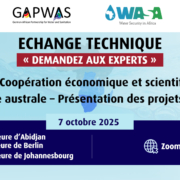
On October 7, 2025, the African Water and Sanitation Association (AfWASA) and the German Water Partnership (GWP) will host the 13th edition of the “Ask the Experts” webinar series under the framework of the German–African Partnership for Water and Sanitation (GAPWAS).

This new session highlights the WASA (Water Security in Africa) programme, which stands as a flagship example of how scientific exchange and practical cooperation can help strengthen water security and sanitation systems across the continent. Through seven ongoing projects, the WASA programme fosters collaboration between research institutions, utilities and private actors in Germany and Southern Africa to design and test sustainable, locally adapted solutions.

Far beyond a simple presentation, this edition of “Ask the Experts” invites participants to discover concrete results achieved on the ground, share experiences from both continents, and explore new avenues for scientific and economic partnership in the water and wastewater sectors.

By bringing together engineers, researchers and decision-makers, the webinar continues to build a bridge between two regions united by a common vision: ensuring access to safe water and sanitation for all, while promoting innovation and resilience in the face of climate and demographic challenges.

Participation in this online session is free of charge, reaffirming the shared commitment of AfWASA and GWP to make knowledge and expertise accessible to the entire professional community working for a sustainable water future in Africa.

Documents to dowload : 
 

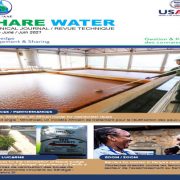
SHARE WATER 11

This eleventh issue of the African Water Association’s semi-annual bilingual Technical Journal “SHARE WATER” explores innovative and good practice solutions to build resilient and sustainable African cities. Thus, the various articles proposed, including a brilliant case study on sludge recovery practices for a circular economy in Senegal, focus on the steps to be taken to achieve inclusive sanitation at the scale of cities in Africa. In addition, alternative solutions to water stress are proposed for better management of water resources: the Windhoek wastewater reuse model, the intercommunality underpinned by the ATPC (Community-Led Total Sanitation) approach which leads to the establishment of a water and sanitation technical service in a municipality in Niger, Molecular Bi-Orientation for high-quality PVC pipes that comply with international standards, the production of drinking water from ambient air or the treatment of water with solar energy in four West African countries.

Download

Chlorination and safety : Overview

Water borne disease has been a major global killer since time inmemorial. In 2019 an estimated 3.4 million people died of PREVENTABLE water borne infection. It’s why disinfection is so important. Chlorine Gas, Calcium Hypochlorite 65% HTH, On Site Electrolytic Chlorination, Chlorine Solution Mixing, Analysers, Ozone Disinfection, Ultra Violet Disinfection are various solutions delivered by EVOQUA for disinfecting large reservoirs or sterilizing large water supply.

Innovative smart metering system for water

The using of traditional water meters often leads to difficulties like long collection period, low collection ratio and high Non Revenue Water. Smart Water Meters is a brilliant system to overcome these difficulties. For example, in Zambia the performance increased to 65% after pre-paid meters installation by National Water and Sewerage Corporation (NWSC). Benefits of smart metering system are : compatibility with Africa Water Utilities, no more historical debt, cash flow improvement, automatic data collection, customer persona, efficiency improvement.

Planning for a water secure city: A case study of Kampala, Uganda

The management of water resources is a big challenge in Uganda. Then, it’s important to ensure water security. This document gives details on Water Security Action and Investment Plan Project (WSAIP) for Greater Kampala Metropolitan Area, in order to support sustainable social and economic development in Uganda.

BILAN ANNUEL 2020 DE LA COOPERATION DECENTRALISEE ET NON GOUVERNEMENTALE – BURKINA-FASO

Chaque année le pS-Eau référence les projets portés par la coopération décentralisée et non gouvernementale française intervenant sur le secteur de l’Eau, de l’Assainissement et de l’Hygiène. Ce document fait le bilan annuel 2020 du Burkina Faso des projets ayant bénéficié d’un financement de la part de collectivités territoriales et agences de l’Eau françaises durant l’année 2020. Depuis 2006, environ 480 projets de coopération ont été recensés au Burkina Faso, représentant un total de plus de 56 millions d’euros.